Drawings
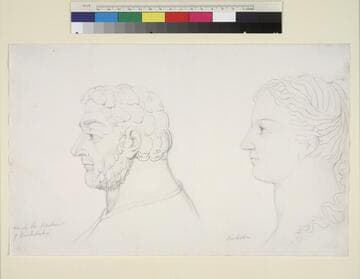
Socrates

- Date
- ca. 1819-1820
- Accession number
- 000.50
- Maker
- William Blake(Opens in new tab) (British, 1757–1827)
- Dimensions
- 8 11/16 x 5 13/16 in. (22 x 14.8 cm.) sheet: 12 5/16 x 7 15/16 in. (31.3 x 20.1 cm.)
- Medium
- graphite pencil on paper
- Description
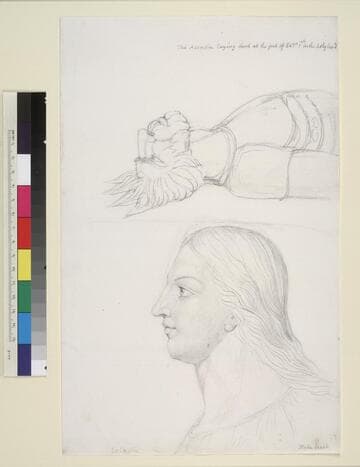
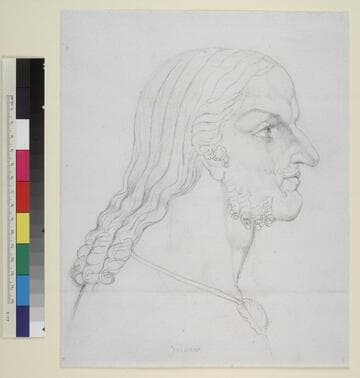
- Blake's drawing in near profile looking to the left is generally similar to traditional portraits of Socrates, such as the sculpted bust in the Farnese Gallery (reproduced in a mid-eighteeenth-century engraving by George Vertue) and a profile engraved by Michael Van Der Gucht (1660-1725). There is also a group of eight outline profiles of Socrates in Lavater's Essays on Physiognomy, 1:*175, some quite similar to Blake's drawing except for his distinctive treatment of the eyelid. Mellor 1978, 67-69, has analyzed the prominent segmentation of the forehead of Blake's "Socrates" as a response to Lavater's comments on the philosopher's physiognomy and to Spurzheim's phrenological principles. Blake's several written references to Socrates (469-399 B.C.) offer a mixture of criticism for the Athenian philosopher's analytical rationalism and praise for his intellectual independence. Blake seems to have identified with Socrates as a fellow victim of malicious critics. On plate 93 of Jerusalem (ca. 1804-20), Blake pictured three figures, each inscribed with the name of one of Socrates' accusers, as a historical parallel to the trinity of false accusers (Hand, Hyler, Scofield) in Blake's reconstitution of his own life into myth. Such associations were supported by what Blake believed to be a similarly between his physiognomy and Socrates'. In 1825, Henry Crabb Robinson asked Blake, "What resemblance do you suppose is there between your Spirit & the Spirit of Socrates?" Blake replied, " 'The same as between our countenances.' He paused & added, 'I was Socrates.' And then as if correcting himself: 'a sort of brother-I must have had conversations with him-so I had with Jesus Christ-I have an obscure recollection of having been with both of them.'" [1] One of the physical resemblances Blake refers to was a snub nose, prominent in the "Visionary Head" and several of the profiles in Lavater. Blake also believed that Christ shared this feature: "The Vision of Christ that thou dost see/ Is my Visions Greatest Enemy/ Thine has a great hook nose like thine/ Mine has a snub nose like to mine." [2] One of the profiles on the verso of this "Visionary Head" is similar to a face, also probably by Varley, on page 12 of the Blake-Varley sketchbook (private collection, England; Butlin 1981, No. 692.12). Two of the verso sketches also bear some resemblance to a portrayal of "Conceit" in Varley's Zodiacal Physiognomy. Another visionary head of Socrates, drawn ca. 1820, is in the Yale Center for British Art. [3] This portrait is very similar to the Huntington drawing, but shows the face in full profile, without the brow ridge of the right eye, and with a smaller left eye. A tracing, probably by Linnell, of the Huntington version is in the collection of G. Ingli James, Cardiff (reproduced in James 1979). Notes 1. Bentley 1969, 310. 2."The Everlasting Gospel," ca. 1818; Blake 1982, 524. Five lines later, Blake mentions Socrates, again in the context of false accusation and martyrdom. For a discussion of these interconnections between Blake, Jesus, and Socrates, see David V. Erdman, " 'Terrible Blake in His Pride': An Essay on the Everlasting Gospel," in From Sensibility to Romanticism, ed. Frederick W. Hilles and Harold Bloom (New York: Oxford Univ. Press, 1965), 343-44. 3. Butlin 1981, No. 926. Also reproduced in Keynes 1927, Pl. 44.
- Credit
- The Huntington Library, Art Museum, and Botanical Gardens
- Department
- European Art
- Find out more
- View in the Art Museum catalog(Opens in new tab)
test label text
You might also be interested in
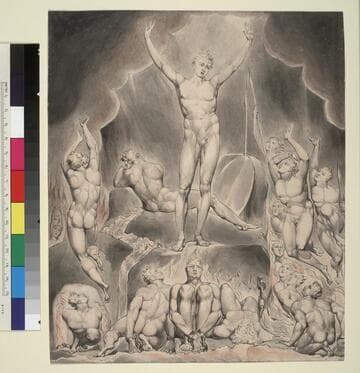
Illustration 1 to Milton's "Paradise Lost": Satan Calling Up His Legions
Decorative arts
William Blake
000.1