- Date
- ca. 1819-1820
- Accession number
- 000.49
- Dimensions
- top image (The Assassin): 3 9/16 x 6 5/8 in. (9 x 16.8 cm.)
bottom image (Saladin): 6 7/16 x 5 1/4 in. (16.3 x 13.3 cm.)
sheet: 12 5/16 x 7 7/8 in. (31.3 x 20 cm.)
- Medium
- pencil on wove paper
- Description
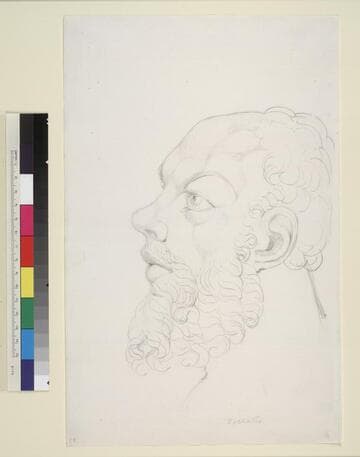
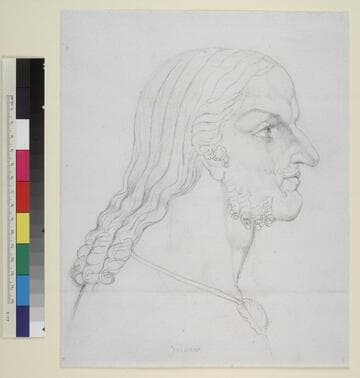
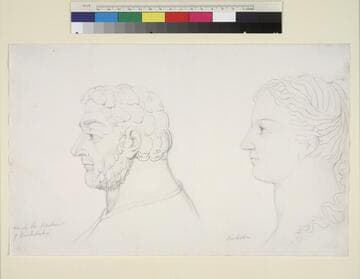
- Two drawings on one sheet.
In 1272, an Assassin stabbed Prince Edward, later King Edward I, with a poisoned dagger. Blake had long been interested in this incident-see the third "Visionary Head," above. He may have been attracted to legends concerning Edward I as a result of his having drawn two pictures of the King's corpse when his tomb in Westminster Abbey was opened on 2 May 1774 (Society of Antiquaries, London; Butlin 1981, No. 1, 2). As Rossetti 1863, 244, notes, the bust of the would-be assassin is oddly "leonine." Indeed Blake would seem to be using the animal transformation technique of caricaturists and cartoonists to visualize literally a "beastly" character.
The profile of Saladin (1138-93), famous for his chivalry, is that of a noble youth. As Rossetti 1863, 244, suggests, it is the "kind of head that might do for John the Evangelist." Although the great Moslem leader fought against the Crusaders in the Holy Land and was an enemy of the secret society of Assassins, there is no direct historical connection between Saladin and Edward I.
- Credit
- The Huntington Library, Art Museum, and Botanical Gardens
- Department
- European Art